Archive for the “exercises” Category
Position: A supine position on the floor with the knees straight and the heels together. The bar is held at straight arms’ length over the chest with the elbows locked.
Action: From this position, the arms are lowered overhead, keeping the elbows rigid or locked. The moment the knuckles touch the floor the bar is returned to the starting position over the chest.
Breathing: Inhale as the bar is lowered to the floor and exhale as it is raised over the chest.
Progression: The movement should be started with 10 counts and 2 counts added each
week until 20 have been performed for 3 exercise periods. Then 2½ lbs. should be added to the bar and the motion begun again at 10 counts with the repetitions increased as before. It is well not to exceed 25 lbs. resistance in this exercise. If a heavier weight is used, the ribs will become fixed to act as a base or origin for the
muscles to raise the weight and the rib box will not be expanded for the desired effect.
Goal: Girls and women should work up to a resistance of 15 lbs.
Boys and men should work up to a resistance of 25 lbs.
Comments: The breathing in this movement is very important. When the bar is lowered, the lungs must be full of air when it touches the floor. The purpose is to stretch the walls of the chest, not to lift a heavy weight. If a heavier weight than 25 lbs. is used, the elbows must be bent to relieve the shoulders of unnecessary strain and to permit full expansion of the rib box.
This movement with the elbows bent is used as an advanced exercise and the weights used can be worked up to 50 of 75 lbs.
Rather than to use a heavy weight, it is better for the individual to keep using the 15 to 20 lb. bar and place a low stool under the shoulders. With the body in this position, the bar can be lowered further and the ribs stretched a little more. This is quite severe and should not be used until the chest is thoroughly accustomed to the pull over in the regular manner.
In arranging a program, this movement should follow an exercise for the back or legs, for those movements stimulate the volume of breathing making the stretching of the rib box more effective.
It is not uncommon for youngsters to gain as much as 3 inches in the normal chest circumference in as short a time as six weeks.
No Comments »
Position: A supine position on the inclined board with the feet uphill. The knees are straight but the feet are not under the strap. The hands should grasp the sides of the board.
Action: Keeping the knees straight and the feet together, the legs are raised until they are at right angles to the board. The movement is then continued until the legs are well over by the head. Some will be able to bring them over until the toes touch the board or the floor. Keeping the knees straight, the legs are returned to the starting position, exhale as they are carried overhead, inhale as they return to the perpendicular position and exhale as the heels return to the board.
Starting Resistance: In this movement, the weight of the legs provide the necessary resistance.
Progression: This movement is best begun at 5 counts with 1 count added each week until the desired maximum is reached, which may be anywhere between 20 and 50 counts.
Goal: All should work up to at least 20 counts in this movement.
Results: This exercise aids in strengthening the lower section of the abdominal wall. As the legs go beyond the perpendicular position to overhead, the lumbar curve in the lower back is straightened, relieving pressure on the spinous processes and inter-vertebral discs.
Comments: This is a comparatively mild exercise and is a good one to use at the beginning of a program. Because if its value as a movement to relieve pelvic pressure and congestion and low back discomfort, it is especially recommended for girls and women.
Because of poor posture and abdominal tone, the pressure of abdominal viscera may lie quite heavily on the pelvic organs. This overhead movement will aid greatly in restoring the abdominal organs to better position which will relieve the pressure on the pelvic organs.
In cases of malposition of the uterus, it will aid greatly in restoring it to proper position. Many cases of faulty menstrual function have disappeared entirely with an improvement in posture and abdominal tone.
No Comments »
Position: A supine position on the board with the head toward the upper end. The upper end of the board or the strap is held in the hands to keep the body in position. The knees are bent up toward the chest until the low back is flat against the board and the heels are 8 to 12 inches above the board.
Action: From this position, keeping the legs relaxed, the knees are brought strongly toward the chest so that the hips are raised as high as possible off the board. The hips are then lowered back to the board until the low back is flat again upon it.
When this point is reached, the knees are brought again up toward the chest and the hips raised as before. Most of the effort of the motion should be made with the abdominal muscles with the pull of the arms used as little as possible. When the low back is returned to the board, the legs must not be permitted to sag down toward the board, otherwise the hip flexor muscles will assist in the motion and destroy some of its effectiveness for the lower waist.
Breathing: Exhale as the knees are brought up toward the chest and inhale as the hips are lowered back to the board. This will seem quite opposite to the natural inclination, but when the abdomen is compressed as in this motion, the air should be expelled.
Starting Resistance: In this movement, the weight of the legs will supply the necessary resistance.
Progression: Begin the motion with 5 counts, adding 1 count each week until 20 or more have been performed. There is no fault with doing more than 20 counts, even working up to 50 counts, if the effort is not too great.
Goal: All should work up to at least 20 counts in this motion.
Results: This exercise is a specific motion to strengthen the lower part of the abdominal wall. It will aid greatly in developing or restoring good support in the lower abdomen.
Comments: This motion is more difficult than it appears to be. In the beginning a very strong pull with the arms may be required to get the hips off the board. As strength is built in the abdominal muscles, less effort is required of the arms. During the exercise constant attention will be required to prevent the legs returning closer to the board when the low back returns to the board. This is a relatively advanced exercise and one of the best for the lower waist.
Good abdominal tone is necessary to support the viscera and pelvic organs properly, relieve blood congestion and promote better return circulation to the heart. In addition, the contraction and extension of the abdominal muscles aid very materially in the peristalsis of the large colon. With regular exercise the use of any cathartic, however mild, is unnecessary.
The strength and tone of these muscles are strong factors in maintaining a correct curve in the lumbar spine, so that the curve is not accentuated causing low back pain and discomfort.
Lack of abdominal tone and support of the viscera causes pressure on the pelvic organs. This pressure interferes with the flow of blood in the iliac veins and arteries in the pelvis. This condition is at the very least, a strong contributor to the condition of varicose veins in the legs. An improvement in muscle tone and body mechanics has a most favorable effect on the symptoms of varicose veins.
No Comments »
Position: A standing position with the feet wide apart; the farther apart, the better. Both hands are at the sides and a dumbbell is grasped in one hand only.
Action: Keeping both knees locked, the trunk is bent directly to the side on which the dumbbell is held until the weight is level with the knee joint. The body is then brought back to the erect position and the trunk is inclined slightly past the perpendicular on the other side.
During the movement the elbow of the lifting arm and the knees must remain straight. After doing the required number of counts on one side, the dumbbell should be shifted to the other hand and the movement repeated the same number of times on that side.
Breathing: Exhale as the body is inclined to the side and inhale as the erect position is regained.
Progression: This motion should be started with 7 counts on each side and 1 count added each week until 12 counts have been performed on each side for 3 periods of exercise. Then 2½ lbs. or 5 lbs. should be added to the weight and the motion begun again at 7 counts.
Goal: Girls and women should work up to a resistance of 25 lbs, with counts up to 20 on each side when it is not too difficult. Boys and men should work up to a resistance of 50 lbs. in this motion. The heavier body types will find extra benefit if they work up to 20 or more counts on each side instead of the recommended 12.
Results: This movement has the same effect on the muscles and organs as the side exercise previously described. It is a more advanced movement than the other because all of the resistance is on one side of the body, making it more effort to regain the erect position.
Comments: In this exercise, as in the side exercise with the bar on the shoulders, there is a tendency to lean too much to the front. The best results are had by bending directly to the side.
No Comments »
Position: A standing position with the feet fairly wide apart and the knees straight. The barbell is held across the shoulders, behind the neck.
Action: From this position, keeping the knees locked, the trunk is inclined forward until it is parallel with the floor, then returned to the upright position. The head is kept up as the body is bent forward and raised, to aid in the contraction of the back muscles.
Breathing: Exhale as the trunk is inclined forward and inhale as the erect position is regained.
Results: This motion will strengthen all the muscles of the back, from the hips to the skull. It will aid in developing and maintaining erect posture without muscle fatigue. It aids materially in holding the shoulders back and the head up.
Comments: These back muscles are meant to be very strong. They originate on the pelvic bones and sacral vertebrae and ascend the back in branches up to the base of the skull. They have a variety of attachments, making them very strong in action. It is very important that these muscles be developed and strengthened in the growing child.
Many pains, discomforts and disabilities have their origins in a weak lower back because of poor tone and development in these muscles.
No Comments »
Position: A standing position with the feet a comfortable distance apart, the knees locked and the barbell held in front of the legs with the elbows straight.
Action: Keeping both knees and elbows straight, the trunk is bent forward as far as is comfortable, then the erect position is regained.
Breathing: Exhale as the body is bent forward and inhale as the erect position is regained.
Starting Resistance: Most women will find a starting resistance of 25 lbs. quite comfortable and most men 40 lbs.
Goal: Girls and women should work up to a resistance of 50 lbs. Boys and men should work up to a resistance of 100 lbs. or more.
Results: This movement will develop and strengthen the large muscles of the lower back and will also strengthen those of the hips and back of the thighs. It is very necessary that these muscles be well developed and strong. They protect the spine and sacro-iliac joints from injury and their strength gives a margin of safety against low back pain and discomfort.
Comments: As the back is bent forward, the muscles in the back and the back of the legs are stretched extensively.
Because of differences in anatomical construction and flexibility, some children and adults will be able to bend forward and touch the floor easily, while others will not be able to bend much more than half the way down. The exerciser should not bend any further forward than is comfortable, but with practice the back will become more flexible and very strong.
In the fully stretched position with the knees locked and the hands close to the floor, much pressure is placed upon the inner borders of the intervertebral discs. The untrained individual invites low back trouble by lifting heavy objects in this position. The proper position to use in lifting heavy objects from the floor is to make the effort with the knees bent and the back relatively flat so that much of the effort is taken by the legs and the back is kept in relatively good position.
In advanced training of athletes who need great strength in the lower back, this movement is used through a short range of movement with very heavy resistance. The movement is started from a standing position and the bar is lowered to about the height of the knees.
During the motion the lower back is kept flat and fixed (never permitted to “round”) and the motion is made almost entirely from the hips. In this position the lumbar spine is kept in a strong position with little pressure on the front borders of the vertebrae. The bar is usually lowered to a predetermined height regulated by some support set at that position for the bar or weights to touch.
No Comments »
An inclined board is a board so arranged that it will permit the user to perform the abdominal exercises with the body at an angle to the floor.
This apparatus is a board about 20 to 24 inches wide and 6 or 7 feet long, with a strap across one end of it. The end with the strap is placed on a stand or fastened to the wall to give the desired slant to the incline. The steeper the slant of the board, the move difficult is the exercise. For most purposes, the height of the raised end of the board should be about 20 to 24 inches from the floor.
The incline permits the abdominal muscles to exert their pull over a longer range of movement. In movements with the feet held by the strap, the weight of the abdominal viscera is toward the chest cavity. This relieves any possibility of pressure against the muscle wall by the viscera during the exercise. This is especially helpful if the individual has a small hernia or a tendency toward one.
The Sitting Up Exercise on the Inclined Board
Position: A sitting position on the board with the knees straight and the feet hooked under the strap to prevent sliding down the board. The hands are clasped behind the neck, or the arms are extended in front. (If the motion is difficult with the hands behind the neck, the motion should be performed with the arms extended toward the toes.)
Action: Keeping both knees straight and the chin on the chest, the exerciser leans backward until the lower back can just touch the board, then he returns to the sitting position. If the arms are extended in front of the body, lie should sit up until he can touch the toes, or as nearly as possible. If his hands are clasped behind the neck, he should try to touch his elbows on his knees each time he comes up.
Breathing: Inhale as the shoulders are lowered and exhale as the sitting position is regained.
Starting Resistance: In starting this movement, it will be sufficient to hold the arms extended in front, if the movement is rather difficult. If the movement is easy, the hands should be clasped behind the neck.
Progression: The exercise should be started with 5 counts adding 1 count each week until 20 have been performed for three periods. If the movement was performed with the arms extended and the 20 counts completed, the motion should be gin again at 5 counts with the hands then clasped behind the neck. When the 20 counts have been done with the hands clasped behind the neck, a light weight (2½ lbs.) should be held in front of the neck under the chin and the motion begun again at 5 counts. The usual amount of added resistance each change is approximately 2½ lbs.
Goal: Girls and women should work up to a resistance of 20 counts with the hands clasped behind the neck. Some will find that they are able to do the motion with as much as 10 lbs. held in front of the neck and when this is possible additional benefit will be had.
Boys and men should work up to a resistance of 25 lbs. in front of the neck, performed for the 20 counts.
Results: This movement strengthens all the muscles of the abdominal area but particularly the front abdominal muscles. When the motion requires more effort, the muscles in the side walls of the waist are brought into action more strongly.
Comments: It is more difficult to do these movements on the inclined board than it is on the floor. There is also a greater tendency to go completely back on the board till the head and shoulders touch the board. This should not be done . . . it is most important that the trunk go back only as far as necessary for the lower back to touch the board. When the low back touches, the sitting position should be regained with no relaxation of the contraction of the waist muscles. If the head and shoulders are permitted to touch the board, we activate too much forward pull on the lumbar spine by the deep psoas muscles.
No Comments »
Position: A standing position with the feet a comfortable distance apart, the arms at the sides with a dumbbell held in each hand.
Action: From this position, keeping both elbows straight, raise the dumbbells directly to the sides and overhead in one continuous motion, lower them to the starting position and repeat the motion. Keep the elbows straight throughout the movement.
Breathing: Inhale as the arms are raised and exhale as they are lowered.
Starting Resistance: Women can begin this one with 5 lbs. in each hand, but if it is difficult it is better to use 2½lbs. Men can begin the motion with 7½ lbs. in each hand Progression: Begin this exercise with 7 counts, adding 1 count each week until 12 have been performed for three periods, then add 2½lbs. to each weight and begin again at 7 counts.
Goal: Girls and women should work up to 10 lbs. in each hand. Men and boys should work up to 20 lbs. in each hand.
Results: This movement will develop and strengthen the muscles on the points of the shoulders (deltoids), which give width to the shoulders. It also involves the muscles that control the shoulder blades and like all overhead movements with resistance, aids in the full development of the rib box.
Comments: This is a leverage movement in that the resistance is a long way from the muscles supplying the effort. For this reason, progress is necessarily slow in regard to increasing the resistance.
No Comments »
Position: A standing position with the feet a comfortable distance apart and the barbell held in front of the legs with the palms of the hands facing the body. The hands are quite close together, about 4 inches apart.
Action: From this position, the arms are bent and the bar is pulled up until it reaches the upper part of the chest, under the chin.
During the raising of the bar the elbows must be kept higher than the wrists as shown in the illustration. The bar is then lowered to the starting position and the motion is repeated.
Breathing: Inhale as the barbell is raised to the upper chest and exhale as it is lowered to the starting position.
Starting Resistance:Women can start this motion with 15 lbs, and men with 35 lbs.
Progression: Begin the motion with 7 counts, adding 1 count each week until 12 have been performed for three periods. Then add 2½ or 5 lbs. to the bar and begin again at 7 counts.
Goal: Girls and women should work up to a resistance of 40 lbs. Boys and men should work up to a resistance of 80 lbs.
Results: This is a fine movement to strengthen and develop the muscles of the shoulders and the upper back. It too, is helpful in correcting round shoulders.
Comments: As the effort in this exercise increases, there is a strong tendency to lean forward at the start of the movement and backward as the bar is being raised. This must be discouraged, for the movement must be done with the strength of the arms and shoulders with no help from the larger muscles of the back.
No Comments »
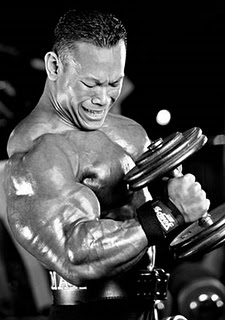
Position: A standing position with the arms at the sides and the feet a comfortable distance apart. A dumbbell is grasped in one hand with the palm of the hand to the front.
Action: Keeping the elbow at the side, bend the arm and raise the dumbbell to the upper chest or shoulder and lower it again to the starting position and repeat the motion.
Breathing: Inhale as the dumbbell is raised and exhale as it is lowered to the starting position.
Starting Resistance: Women should begin the motion with 7½ lbs. and men with 15 lbs.
Progression: Begin the movement with 7 counts, adding 1 count each week until 12 counts have been performed for three periods. The weight should then be increased by 2½ lbs. and the motion begun again at 7 counts.
Goal: Girls and women should advance to a resistance of 20 lbs.
Men and boys should advance to a resistance of 35 lbs.
Results: This movement, like the Two Arm Curl is to develop and strengthen the muscles on the inside of the upper arms and forearms.
Comments: The main purpose of the One Arm Curl is to strengthen weaker arms to match their stronger mates. After one arm has been exercised the required number of counts, the weight is transferred to the other hand and the motion done the same number of times. If one arm is decidedly weaker than the other, only the weaker arm should be exercised in this movement until it is as strong as the other, then both arms should be exercised the same.
No Comments »
|